



I made a recipe last night that called for one clove of garlic. One singular clove. What was that going to do? There’s a rule in our house: When a recipe calls for garlic, we add at least three cloves no matter what. The rule extends beyond garlic, too. I tend to double almost all the seasoning in most recipes. Half an onion? Nah, I’m throwing in the whole thing. Berry crisps taste better with double the topping. Chili powder gets measured by the palmful. Cheese isn’t technically a spice, but we all know I'm multiplying that amount by two.
Don’t get me wrong. I’m a recipe girl. Spell it out for me. Take me by the hand and walk me step by step through the process. I also know my tastebuds, and they say double it!
I’m sure you do something like this, too. Think about a process that has a clear set of steps you follow, except for that one part you modify because it just works better for you. In the same way we make room for modifications to recipes, we can make room for modifications to evidence-based practices, too. Before we get too far into adaptations, we need to start with fidelity.
Balancing Adaptation with Fidelity
Fidelity is all about understanding how closely you implemented something the way it was intended. Because PBIS is an evidence-based framework with decades of research to back it up, it makes sense we’d want to consider how closely we implement it the way it was intended to be done. Implementation is also more than just your fidelity score. Effective implementation relies on how well you fit an intervention to your context. Did you follow the recipe, or did you chuck in some extra garlic?
We’ve talked a little about fidelity before, but let’s refresh our collective memory.
According to research, when an organization implements a program with fidelity, kids experience positive outcomes two to three times higher than when an organization implements a program haphazardly.1 Researchers also found schools experience improved student outcomes when teachers adapt interventions to fit their context...which almost always results in lower fidelity.2
I know. I’m with you. It’s confusing. Adaptation and fidelity are two concepts that seem to run counter to each other, but they can actually work together. Fidelity matters most when it comes to implementing the core components of an intervention. Almost always, that same intervention comes with more flexible features you can adapt to fit your context. The trick is to use data to help you decide which adaptations to make and when to make them.
Tier 2 Data-Driven Adaptations
Tier 2 offers us a perfect place to explore data-driven adaptations. These supports are ideal for it because they come with standard protocols, and they come with plenty of flexible features to tweak based on individual student needs. Once you’ve matched students to a Tier 2 intervention, you get to decide whether to make an adaptation up front or wait, see how a student responds, and adapt later. These are called horizontal and vertical adaptations.3
- Horizontal Adaptations: The modifications you make to an intervention before enrolling a student based on what you know ahead of time. The types of behavior you see, the function of that behavior, and even some of the interpersonal relationships a student has are all examples of information you might use to implement a horizontal adaptation.
- Vertical Adaptations: The modifications you make to an intervention to increase or decrease intensity during the intervention based on the data you collect. These are adaptations you make based on progress monitoring.
Adaptations are great when you use data to inform the modifications you make! Today we’re going to focus on example adaptations you can make to the Check-in Check-out (CICO) intervention, but you can use data to make horizontal or vertical adaptions in other Tier 2 interventions at your school.
A Quick Overview of CICO
CICO is a program to support students in your building who need a little extra help managing their behavior. The steps go like this:
- Students check in with an adult at the start of the day to be sure they are prepared for class and ready to learn.
- Throughout the day, students check in with teachers and receive points on a card related to how closely they met schoolwide behavior expectations.
- At the end of the day, students check out with an adult to talk about how it all went.
The cycle repeats itself each day. Teams enter CICO data in CICO-SWIS and generate reports to see which students experience success with the intervention, which students might benefit from something different, and how the intervention is working overall.
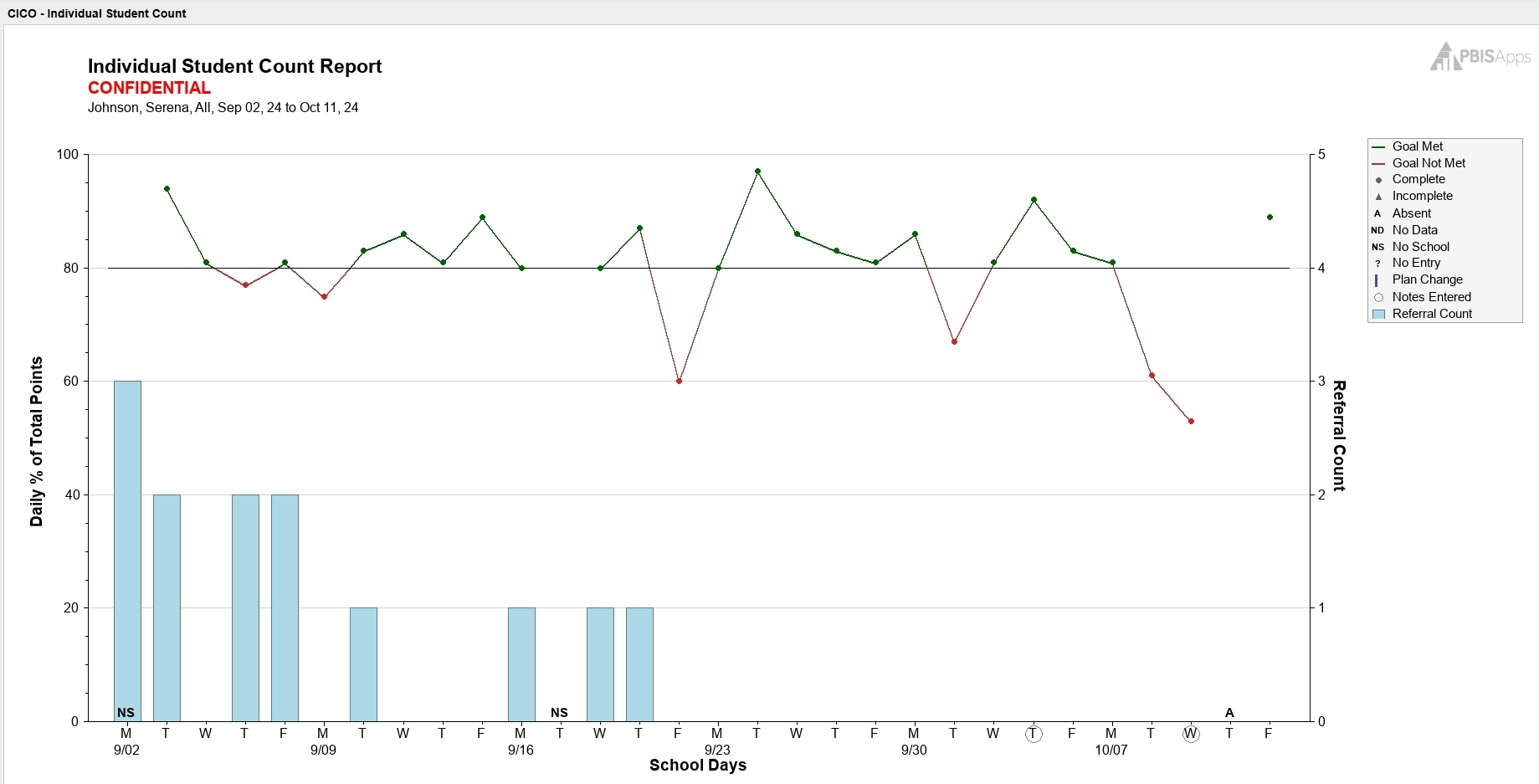
The CICO cycle contains what we call core components – the parts you have to do.
- Someone to check students in at the beginning and end of the day
- A point card based on the schoolwide expectations
- A student goal
- Teacher feedback throughout the day
Within these core components are the malleable features we can adapt. I like to think about these as the fuzzy boundaries we used to test when we were younger. “You said I had to be home by 9:00. You didn’t say I couldn't joy ride with Claire first.”
Except, in this case, the loopholes are about looking for small changes we can make to improve the outcomes we want to see...not about seeing how much we can get away with before my mom or Claire’s gets savvy to our ways. Here are some ideas based on the things you have to do for CICO and the ways you could adapt them to fit your context. Sidenote: For those of you using CICO-SWIS to track student progress in the intervention, the application supports some of the adaptations listed below. For others, take advantage of the plan change setting and notes fields to document the modifications you make.
You Have to Have: A CICO Mentor
The CICO mentor is the person in charge of greeting students in the morning and checking them out at the end of the day. Typically, the mentor is also the person coordinating the overall CICO intervention...but it doesn’t have to be.
What You Could Do: Get Creative About Who That Mentor Is
The mentor needs to be someone with the time and energy to check in and check out with students. In most cases this is an adult in the building, but what if it wasn’t. Peer mentors are an adaptation we’ve seen work well, too. If referral data show you a student is motivated by peer attention, a peer mentor can offer the positive reinforcement they’re looking for. You never know, students who were previously enrolled in CICO and have since transitioned out of it might love to mentor current students through the program.
You Have to Have: Connections to schoolwide expectations
CICO gives students extra practice with schoolwide expectations. The feedback students receive from teachers is based on how closely they followed those expectations in class. It’s important to include what those expectations are on the student’s point card so they have an accessible reference and the feedback they receive is specific.
What You Could Do: Define Behaviors to Work On
While the expectations are important, it’s also ok to get specific about which behaviors students need to practice. For example, if your expectations are to be safe, respectful, and responsible, you can write on the point card the behaviors you think students could focus on related to those expectations. Just pencil in things like:
- Turn in assignments
- Raise your hand before answering a question
- Come to class prepared
- Stay in your seat during personal work time
The idea here is to add reminders about a few behaviors rather than overwhelm the card (and the student) with several. Remember, the card is there as a reference and a way to collect information about the day. You want to keep it simple.
You Have to Have: Student goals
For teams to know whether the intervention is working, you need to set a daily goal each student needs to meet and a goal for the intervention overall. The percent of points each student earns is a good way to measure student success in the CICO intervention. Typically, that goal sits at 80% of the points earned each day...but it doesn’t have to be.
What You Could Do: Individualize goals for each student
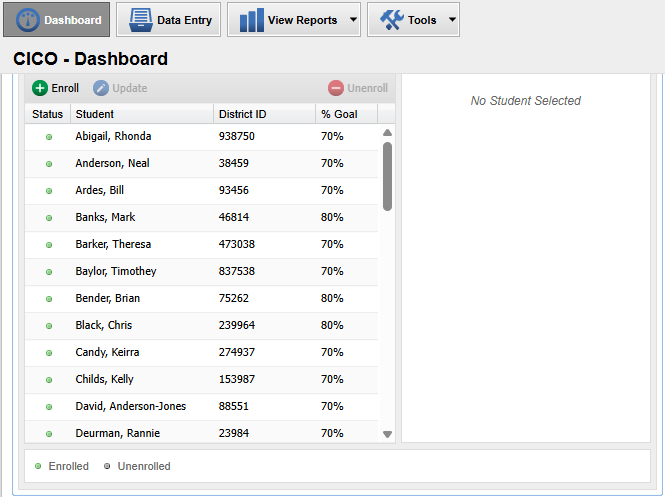
It might not be reasonable to expect students newly enrolled in CICO to earn 80% of their daily points right off the bat. So, set a different goal. Maybe new students have a goal to earn 70% of their points each day. Maybe students who are fading out of CICO transition to a weekly goal instead of a daily one. Students have to have a goal, but if data show they’re struggling to meet the goal you set, why not set a different goal?
Speaking of fading...
You Have to Have: Teacher feedback
This is the heart of CICO. It isn’t about the points students earn; it’s about the feedback they receive from teachers. That feedback strengthens relationships between students and adults in the building while giving them regular information about how they’re doing as they work toward a goal. Typically, this feedback comes at the end of a period or subject...but it doesn’t have to.
What You Could Do: Modify the Feedback Schedule
Most students enrolled in CICO will check in with teachers during the same times throughout the day. A classic CICO adaptation is to increase or decrease the number of opportunities for that feedback depending on what the student needs. Specifically, as students experience regular success, it’s time to think about fading them out of the intervention and into self-management. Instead of checking in six times a day, they might check in just three times: once at the start of the day, again in the middle of the day, and one last time at the end of the day. When you get ready to enter data in CICO-SWIS, just skip the periods the student didn't check in with an adult and the application won't factor them into the overall points earned for the day.
At the end of the day, effective Tier 2 supports aren’t about choosing between fidelity or adaptation. It’s about striking a balance between the two. The core components matter and sticking to them gives an intervention its power. Malleable features are where teams can use data and respond thoughtfully to get students the support they need. When adaptations are intentional, data-driven, and tied to student outcomes, they strengthen implementation. So, go ahead and add the extra garlic, just make sure you’re still cooking the same dish.
1. Durlak, J. and DuPre, E. (2008). Implementation Matters: A Review of Research on the Influence of Implementation on Program Outcomes and the Factors Affecting Implementation. American Journal of Community Psychology, 41(3-4), pp.327-350.
2. Harn, B., Parisi, D. and Stoolmiller, M. (2013). Balancing Fidelity with Flexibility and Fit: What Do We Really Know about Fidelity of Implementation in Schools?. Exceptional Children, 79(2), pp.181-193.
3. Majeika, C. E., Bruhn, A. L., Sterrett, B. I., & McDaniel, S. (2020). Reengineering Tier 2 interventions for responsive decision making: An adaptive intervention process. Journal of Applied School Psychology, 36(2), 111-132.
4. Anderson, C.M., & Borgmeier, C. (2010). Tier II interventions within the framework of school wide positive behavior support: Essential features for design, implementation, and maintenance. Behavior Analysis in Practice, 3(1), 33-45. doi: 10.1007/BF03391756