



I have a theory. If I can do a pullup, I can save my life. It’s a theory almost entirely based on watching action movies where inevitably someone ends up dangling from a cliff, a helicopter, or a radio tower screaming for help when they could have saved themselves with one simple move: a pullup. The trouble is, I can’t do one.
That all changes this year.
My goal is to do one unassisted pullup by October. To do that, I needed a plan. I joined a gym so I can work with a trainer. I’ve got days where I pull weights toward me and days where I push them away (because the pullup to save my life only works if I can then push myself up at the end). I even collect data to watch my progress! Look out, October, I’m coming for you!
The beauty of a plan is how it gets us from point A to point G by defining and then tackling the letters in between. Those baby steps turn a big change into a series of more reasonable, achievable milestones. It works with pullups, and research tells us it works with student behavior, too.
Last month, we explored what it means to think functionally about student behavior. Once you’ve defined why a student behaves the way they do, you’ll probably find yourself asking, “Now what?” It’s time to talk about behavior support plans.
First, a quick review…
Functional Behavioral Assessment (FBA) is a process to understand behavior within a given context. It involves collecting data and using those data to build a behavior support plan rooted in function. While FBA is a part of the Individuals with Disabilities in Education Act (IDEA), we can generalize some of its components to support students outside of special education, too.
Basic FBA is a proactive approach to behavior support planning that relies on simplified FBA procedures. It works well for students whose behavior is:
- Persistent
- Low-Level
- Non-dangerous
- Happening during one or two routines in the day
- Inadequately addressed with current Tier 2 support alone1
Basic FBA makes assessing function a more integrated part of your schoolwide community and gets students the support they need faster. When researchers trained general education teachers on Basic FBA processes, not only were teachers able to name the function of a student’s behavior with 100% accuracy, the behavior support plans they developed were technically adequate (which in research world is really good) and contextually appropriate (which is incredibly important for student success).2, 3 Essentially, once they were trained, general education teachers were able to define the function of their students’ behaviors and create support plans that worked for everyone involved.
We’ve shared the Basic FBA training modules before. They’re still online and you can still access them for free! Building on some of what we learned in last month’s modules, we’re ready to expand our foundation as we develop behavior support plans. 4,5
Building a Competing Behavior Pathway
The Competing Behavior Pathway provides a roadmap for our plan. It starts with the summary of behavior, or the setting event plus the ABCs — Antecedent, Behavior, Consequence. This summary forms the central lane in our pathway.
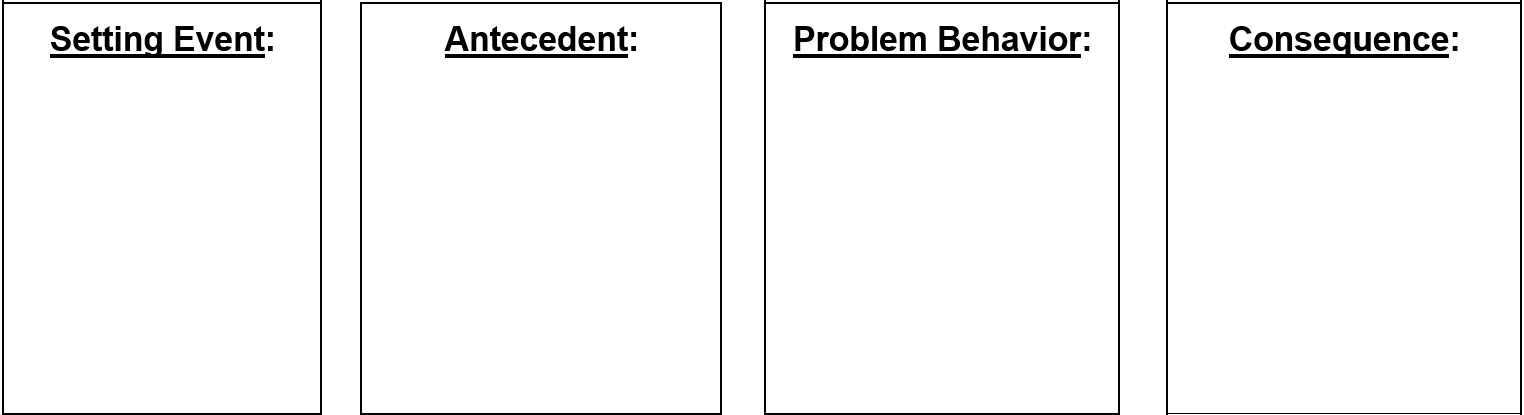
Next, we’ll define what we see as the desired behavior and the replacement behavior for this student.
- Desired behavior is a long-term goal. It should align with your classroom expectations, look as much as possible like what most students do in class, require minimal support from adults to achieve, and help students feel more productive and confident in the classroom.
- Replacement behavior is an acceptable alternative to the current behavior that serves the same function. Some typical replacement behaviors might be: asking for a break, offering the student an easier task, getting peer or adult support, or even breaking up big tasks into smaller ones.
When it’s complete, the pathway looks like this:
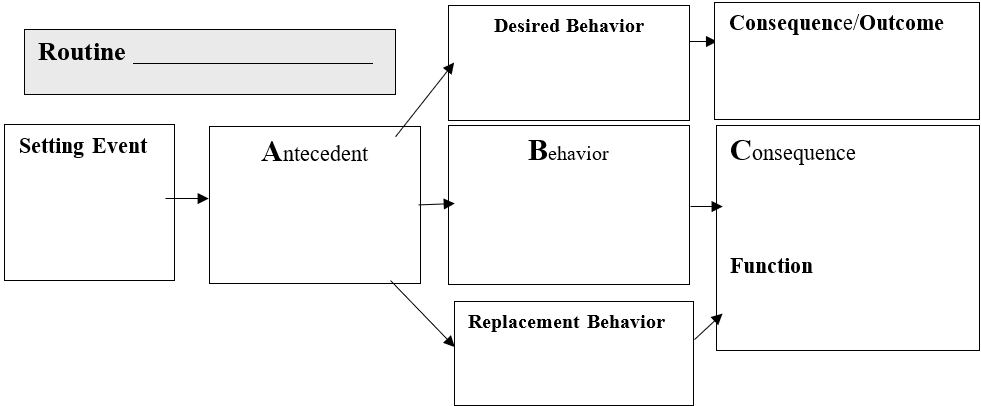
This pathway is the foundation for the rest of your plan, including the data you collect. We love when you can leverage data you already collect to monitor a student’s progress. If referrals, attendance, or work completion give you the data you need to evaluate a student’s success, that’s great! Use those. If you’re interested in something different, we can take a cue from Basic FBA Training: Modules 4 and 5 and build a daily point card (similar to one you might use for Check-in Check-out) tailored to the plan you create.
Because we’re all about a simple approach, let’s answer a few questions and work through an example together to build a basic point card for one student’s plan. Bonus: If your school subscribes to I-SWIS, we’ll include a template at the end for how you can create a point card in the application!
Meet Our Student: Cindy Lou Who

Here’s the behavior summary our team developed for our 4th grade student, Cindy Lou: During reading time, Cindy Lou often wanders around the room and blurts out answers to questions rather than raising her hand. When she does this, her teachers sends her to the hallway or to a buddy classroom so the class can continue with the activity. We know she can read the material. We think she’d just prefer not to do it. We want to encourage Cindy Lou to sit in her seat, raise her hand when she wants to share, and ask for a break when she needs one rather than disrupt the lesson for the other students.
Her pathway might look something like this:
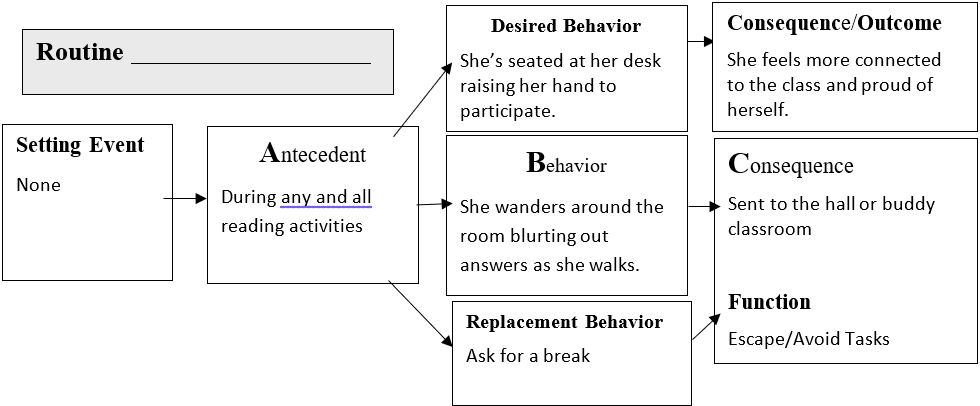
Based on this pathway, we want to create a point card for Cindy Lou to remind her about our classroom expectations and get her closer to joining us as a class during this activity. Let’s ask ourselves a few questions to get this point card suited to Cindy Lou and the behaviors we want to monitor.
Which Progress Do We Want to Track?
When we start a behavior support plan, decreasing unwanted behavior is our top priority. We could choose to monitor how often those negative behaviors happen or we could focus on how often the student follows expected behaviors. Centering those positive behaviors:
- Reminds teachers to look for expected behaviors rather than focusing on the negative.
- Gives students more positive interactions with adults in the building.
- Reminds students about the schoolwide expectations.
- Inches students closer to the desired behavior you ultimately want to see.
So, look at the Problem Behavior box in your pathway. How could you state that positively? In Cindy Lou’s case, we want to turn her inappropriate disruption into more appropriate participation. The behaviors we want to monitor are: raising her hand to share her ideas, sitting at her desk, and asking for a break when she needs one.
What is the Goal?
So much of Tier 3 support is individualized, but the goal doesn’t have to be. If we wanted to standardize a goal for all individualized point cards, we could say we want all students to earn 70% of their points. This simplifies our point card set up and keeps student success front and center in our planning. A 70% goal forces us to ask ourselves, “What can we reasonably expect students to be able to do successfully at least 70% of the time?”
In our example, we set Cindy Lou’s goal at earning 70% of her points. Because her plan is new, we also want to acknowledge her success right away with both a daily goal as well as a weekly goal…both set at 70%.
What is Reasonable?
If we’re thinking about what we believe a student can do successfully at least 70% of the time, we might need to adjust the expected behaviors to help them achieve that success. Think about the incremental steps you can take to move the student from the unwanted behavior you see now, to the desired behavior you want to see in the future. It isn’t reasonable to expect students to go from A to G right away, so take some time to plan steps B-F.
We know Cindy Lou’s behavior relates specifically to reading activities. She stays in her seat and raises her hand at other times during class. In this case, we think it’s reasonable to expect her to do these things during reading at least 70% of the time. Asking for a break is new for her, but we also think the breaks are something she’ll like. We’ll keep that as a behavior on her card, too. If her behavior extends beyond reading into other routines, we can always come back to adjust these expectations.
Based on the pathway we created, the answers to these questions, and after consulting with her teacher, here is the point card we created for Cindy Lou.
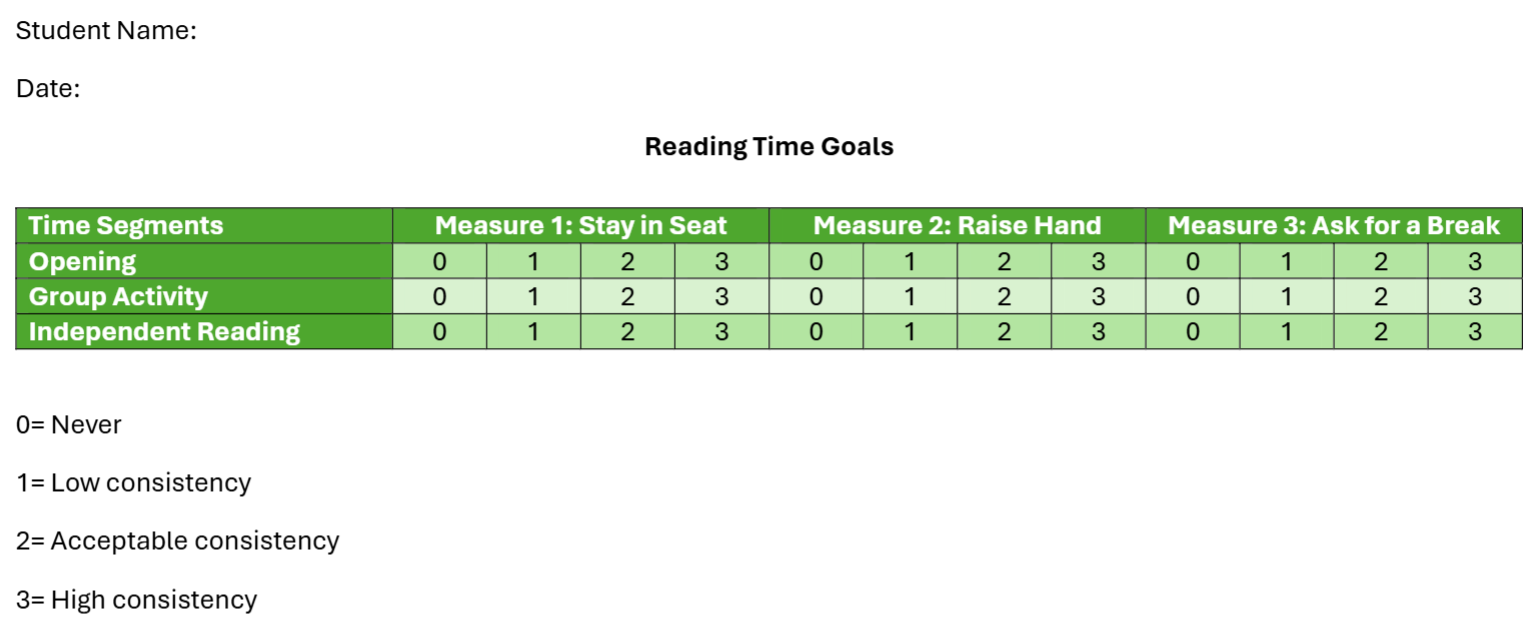
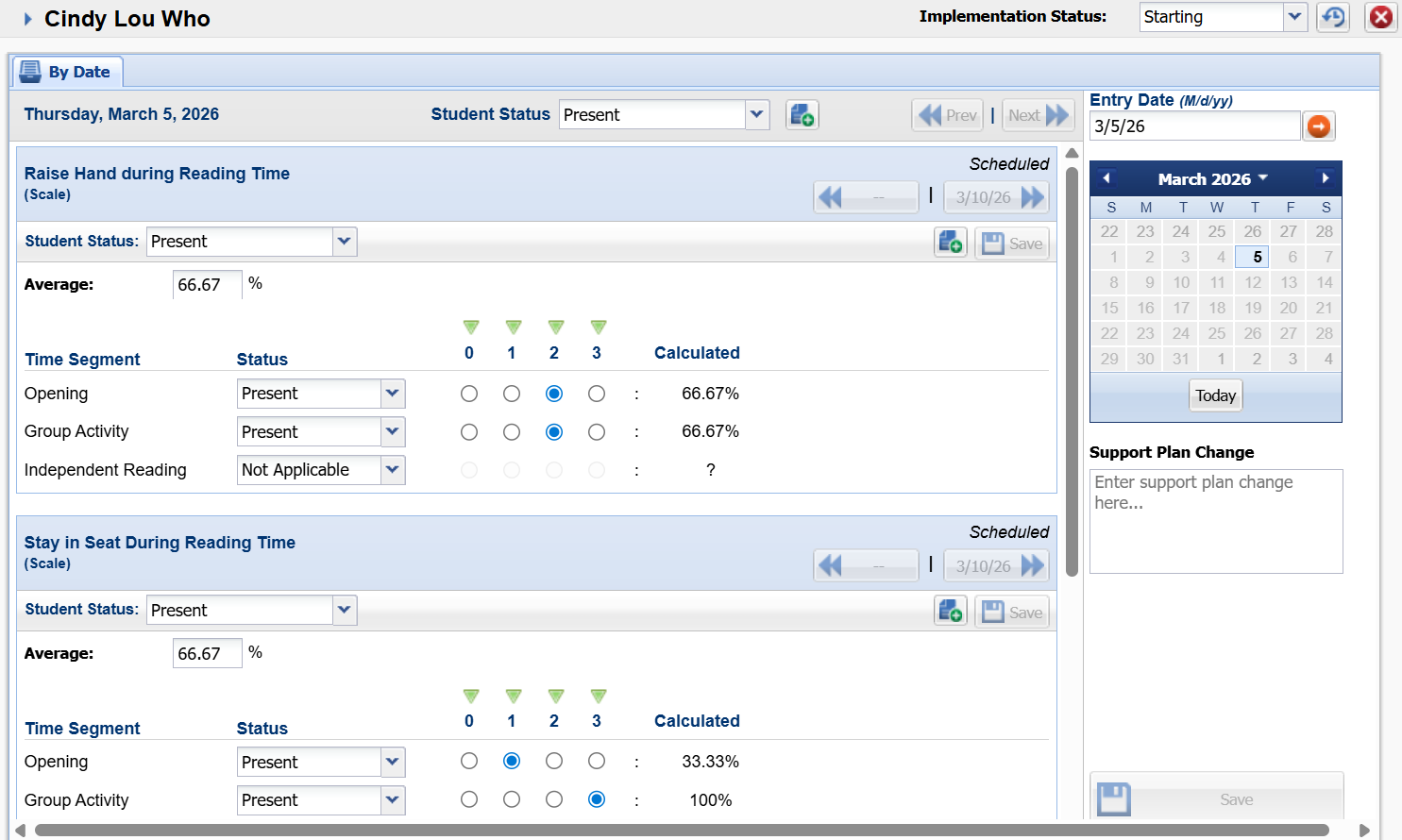
We’ll measure three behaviors during three different activities during reading – our opening activity, our group activity, and our independent reading activity. Her teacher will rate Cindy Lou’s behaviors along a scale of 0 to 3 based on how consistently she’s able to follow expectations. In I-SWIS, her point card looks like this. If you want to set up something similar in your account, here’s a template to follow.
Building a behavior support plan doesn’t happen all at once. It’s an intentional process beginning with understanding the function of the behavior, defining a long-term goal, setting the short-term goals that will help you get there, and choosing simple ways to track progress along the way. Take the time up front to think through the data that will inform your decisions the most, the goals you want to set so students feel successful, and the ways you’ll work with students to get them from where they are now to where they want to be. If that last bit has you intrigued, you’re going to want to check out next month’s article. Stay tuned…