


Referral data tell us a lot about the behaviors happening in your building, when they happen, how often they happen, and who's most likely to be involved. Looking for referral patterns helps you identify issues and offer tailored support sooner rather than later. One of the best times to identify which students would benefit from additional support is in October using a little method we like to call the October Catch.
The October Catch comes from two studies focused on referral trajectories. One study examined 581,775 referrals across 2500 elementary schools; the other examined 403,172 referrals across almost 600 middle schools.1,2 Researchers looked for how many referrals each student accumulated by the end of the year, and whether there is a moment early in the year to intervene and change that trajectory. In both studies, the answer is a resounding YES, and that time is October.
Check out the number of referrals students accumulated on average every month. These are the data from the middle school study; the elementary school data look nearly identical
- For elementary schoolers with six or more referrals, 50% had two referrals by the end of October.
- For middle schoolers with six or more referrals, 71% had at least one referral by the end of October.
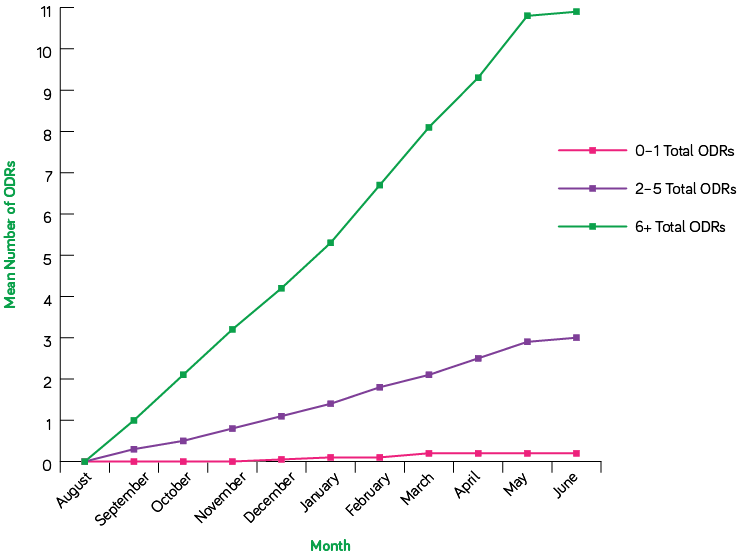
The middle school trends offer us another way to predict student trajectories not found in the elementary data. Would you believe there’s a September trend to watch for? Yep. Research shows 91% of middle school students referred in September for “Defiance” ended the year with six or more referrals.
If you’re like me and you checked the dates on these studies, you noticed they’re from 2010 and 2014. So much has changed between then and now. Does the October Catch hold up? I asked a colleague of mine with access to our research database and a lot more experience with statistics, to run the numbers again. Guess what? They hold true, and that’s a really big deal.
It means when you generate a “Referrals by Student” graph in SWIS, and set the minimum number of referrals to 2, you create a list of students who are more likely than others to end the year with six or more referrals. This is the exact list of students who would benefit from additional support…and it’s only October!

Your PBIS implementation makes predictions like this possible. Your school’s evidence-based, schoolwide systems and practices ultimately lead to more reliable data driving the decisions you make as a team. PBIS comes with a data element baked in. It’s as essential to your multi-tiered system of support as the acknowledgements you provide and the teams you create. The domino effect of predicting student outcomes starts with consistent schoolwide processes resulting in reliable data driving the decisions you make.
Your behavior management processes boil down to four basic parts working together:
- Agreed upon behavior definitions
- Consistent referral processes
- Efficient referral forms
- Proactive response strategies
Agreed Upon Behavior Definitions
Defining behaviors is a critical part of any school’s discipline process. When everyone operates from the same definition, teams can analyze behaviors happening schoolwide, looking for trends and driving the decisions they make. Many behaviors are easy to name, but some are a little harder. What happens when the best way to define a word is with a feeling? Subjective problem behaviors work like that. Words like “disrespect,” “defiance,” “disruption,” we may not be able to define them exactly, but we know them when they happen.
When it comes to our referral process, knowing what subjective behaviors feel like isn’t enough. We need to define them precisely. For every behavior you define, the definition must be observable, measurable, and specific.3
- Observable: Something you can see and describe to another person.
- Measurable: Intensity of the behavior.
- Specific: Boundaries defining what the behavior is and what it is not.
If you don’t have a list of behavior definitions at your school, we have a set you can use as a starting point.
Consistent Referral Process
Routines are one way to keep everyone moving in the same, efficient direction so the end result is reliably similar. Researchers have found when we participate in a process, we tend to learn what works for us and adjust accordingly.4 To keep things consistent, it’s important to define which parts of a process are rules to follow and which parts we can make our own.
.png)
The same is true for your referral process. When you experience a behavior, you need to know which steps to follow precisely and which ones you can adapt to your context. That could be a flowchart or a t-chart or something else entirely. If nothing else, it is important to include steps for:
- When to manage the behavior in your classroom
- When to send a student to the office
- How to decided a consequence
- How to document the behavior
- What to do to follow up after the incident
When you keep your referral process consistent, you ensure all students experience the system equitably.
Efficient Referral Form
If a behavior happens in your classroom and you didn’t document it, did it even happen at all?
When you fill out a referral form, you’re telling someone about the behavior you experienced and how you reacted to it. The form could be full of open text fields with unlimited word counts. While venting on a form can feel good, those data are more challenging to use for decision making. You need a form that’s quick to fill out and one that keeps your data consistent regardless of who fills it out.
Referral forms should come with 10 basic drop-down fields with the same set of selectable responses available to everyone.
- Student Name
- Grade
- Staff Member
- Date
- Time
- Location
- Behavior
- Others Involved
- Perceived Motivation
- Action Taken
Sure, you could have more fields than this. With just these few, your team has all the information they need to reveal behavior patterns schoolwide and make informed decisions benefiting everyone.
Proactive Response Strategies
Behaviors rarely go from calm to full crisis without moving through some phases of escalation along the way. The behaviors you see, refer, and document in SWIS land somewhere within the escalation cycle.5
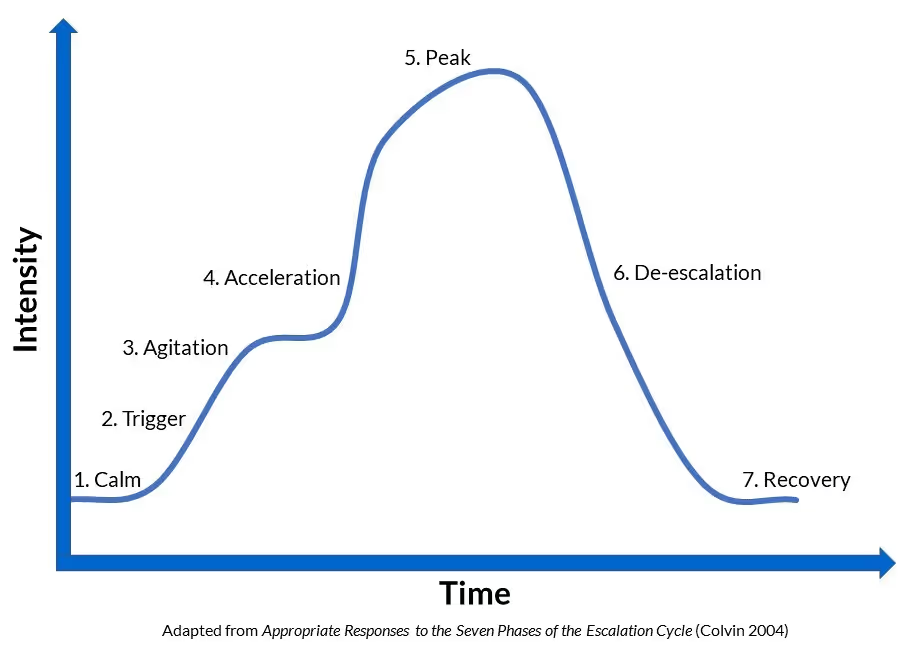
It makes sense to focus on de-escalating after a behavior reaches its peak, but it also makes sense to infuse de-escalation strategies throughout the entire cycle. We have to consider the full continuum of responses available to us.
De-escalation starts with prevention.6 Prevention strategies align with the strong Tier 1 systems and practices you use in your classrooms every day. These are things like:
- Teaching expectations
- Building relationships with students
- Positively reinforcing the behaviors you love to see
- Correcting behavioral errors when they happen
Prevention also relies on teaching everyone the strategies they can use to regulate their own behaviors before they escalate, while they’re in a calm, neutral state.
Depending on where your school is in your PBIS implementation, getting these four components in place might feel overwhelming. The good news is: If your school uses SWIS, you’re probably already doing a lot it. All schools using SWIS agree to use a common referral form with defined categories and labels. Each school has a procedure for when to handle behaviors in the classroom, when to send a student to the office, and what happens next. If nothing else, SWIS schools have a documented, consistent way to manage student behavior…at its best, your team gets reliable data that make it possible for you to get students the support they need faster than ever before.